Feed on
Posts
Comments

Henry Wessells will be speaking at 8:00 p.m. tonight, 14 July 2010, at Readercon, on the topic “Critical Fictions & other Fabulous Beasts; or, Learning to Read/Write all over again”. This will be a talk providing definitions of the critical fiction mode (with examples), as well as reviewing the works of precursors and of contemporary practitioners, and will include readings from works not previously performed in public, including “Book becoming power” and The Private Life of Books”.

An Open Letter to the TLS

To the Editor of the TLS

Sir,

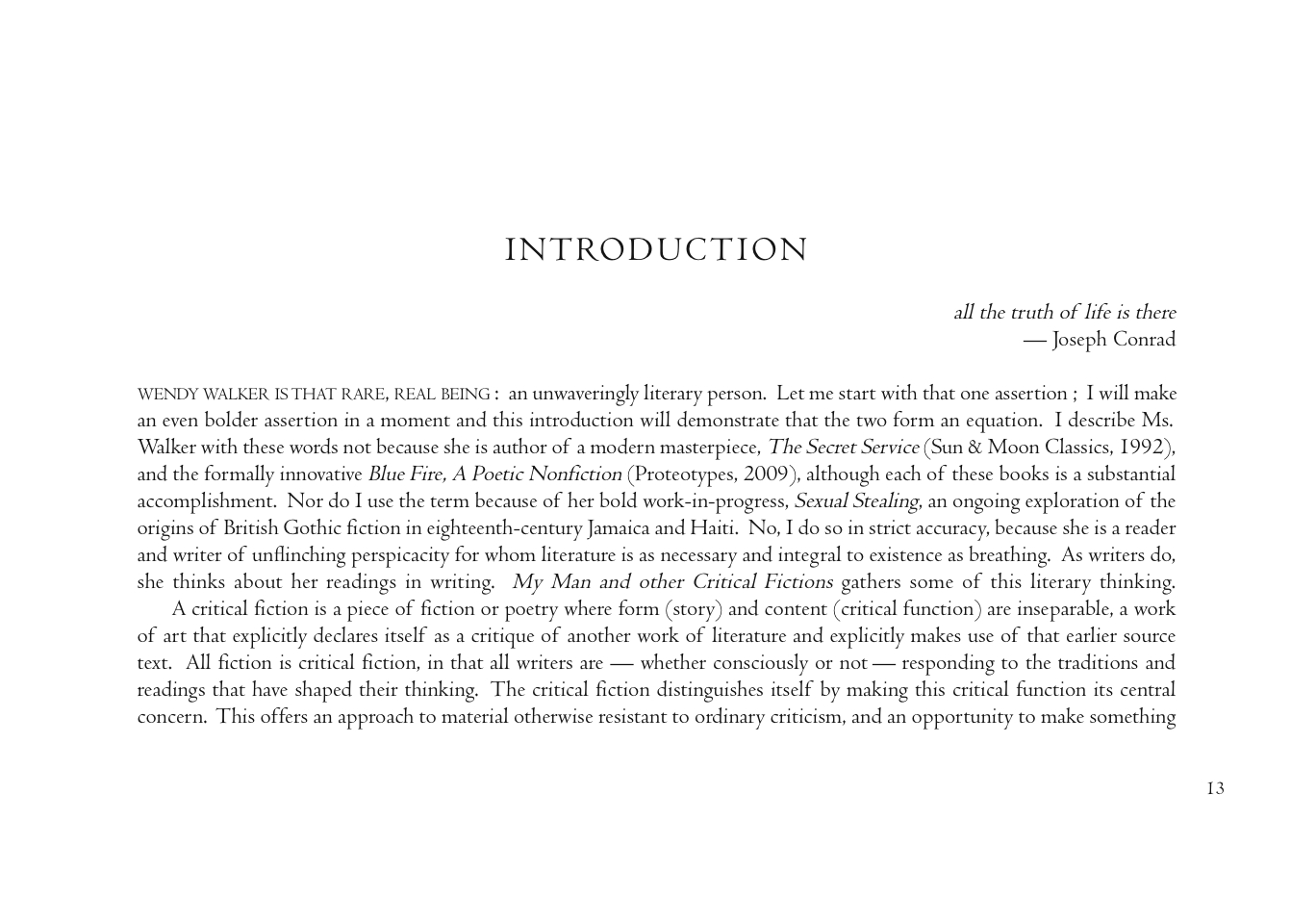
Part of the task of the reviewer is to consider the book at hand as literature, that is, a written work that functions within a context. One part of that context is the history of earlier works that will illuminate the book under review. Context also reveals the aims of the author, especially in experimental writing, and the most insightful criticism will provide an informed sense of what the writer is attempting, and not merely list the reviewer’s norms. Ben Jeffery, in “Pieces of pieces” (24 February), demonstrates his capacity for acerbic categorization, but for him to devote half his column on Sara Levine’s “wispy” Treasure Island!!! to plot summary and quotation, with no mention of, say, Kathy Acker’s Pussy, King of the Pirates (1996), invites questions about his grasp of post-modern literary aims and methods.

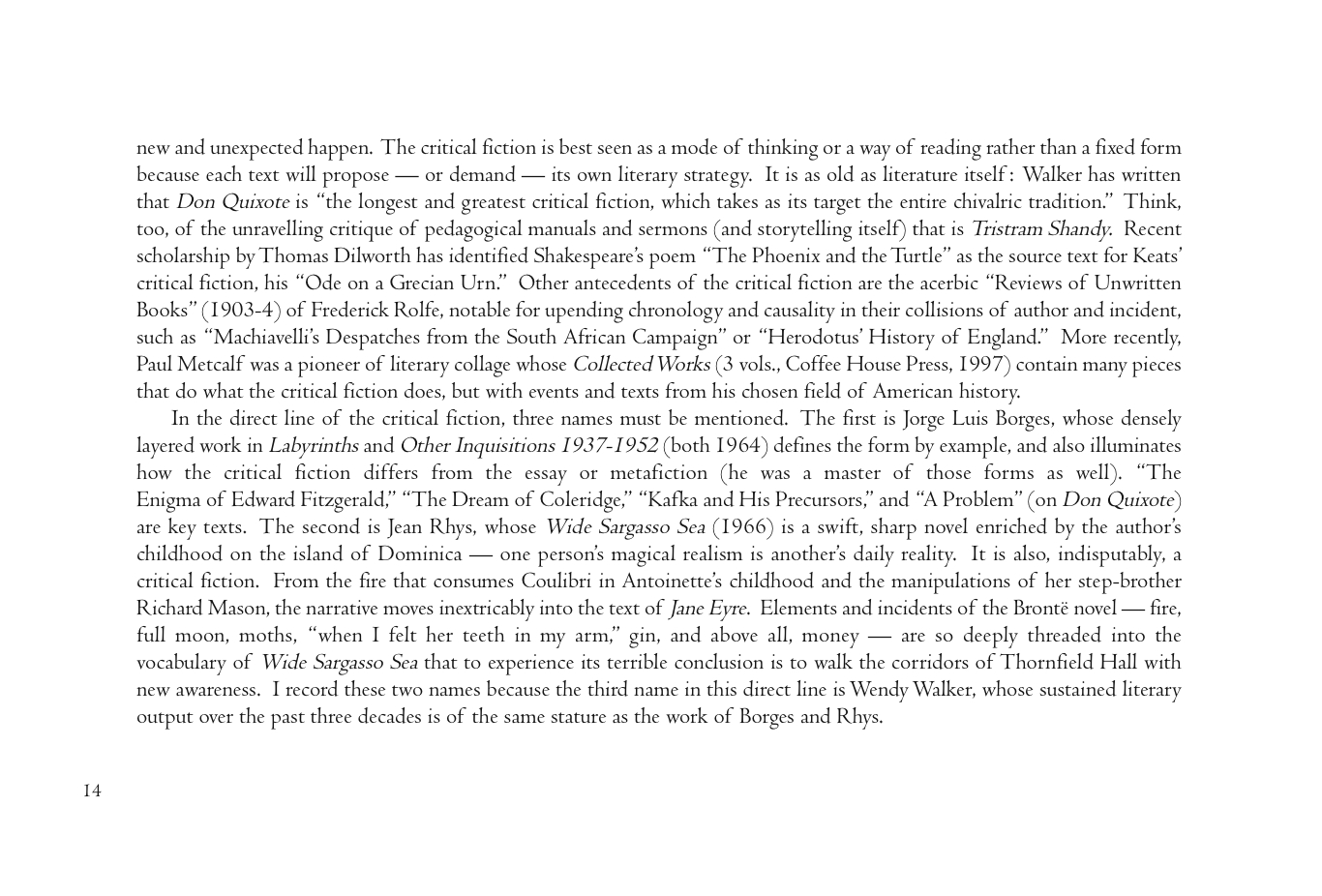
I am pleased that Mr. Jeffery quoted part of a sentence defining the critical fiction from my introduction to Wendy Walker’s My Man and other Critical Fictions in the same review. It might have been more helpful if he had instead chosen the next sentence, “All fiction is critical fiction, in that all writers are — whether consciously or not — responding to the traditions and readings that have shaped their thinking.”  Or if Mr. Jeffery thought to mention such literary precursors as Jorge Luis Borges, or Jean Rhys’ Wide Sargasso Sea (1966), or Angela Carter’s “John Ford’s ’Tis Pity She’s a Whore” (1988).

I’m certain a dance critic could find something interesting to write about the most “austere interpretive dance”; it would involve eliciting the context and meaning of the dance; that is to say: actually doing the work of the critic.


Henry Wessells
P.O. Box 43072
Upper Montclair, New Jersey 07043
USA

My Man and other Critical Fictions by Wendy Walker and Treasure Island!!! by Sara Levine were reviewed by Ben Jeffery  in the TLS for 24 February.


Pieces of pieces

BEN JEFFERY

Sara Levine
TREASURE ISLAND!!! 176pp. Europa. Paperback, $15. 978 1 60945 016 8

Wendy Walker
MY MAN AND OTHER CRITICAL FICTIONS. 138pp. Temporary Culture. $22.50. 978 0 9764660 7 9

Here are two books that each take other literary texts as their foundation, but otherwise could not be less alike. [. . .] Treasure Island!!! is [Sara Levine’s] first novel — a wispy, hyper-caffeinated comedy about a young woman obsessed with Robert Louis Stevenson’s classic pirate tale. Wendy Walker is a New York-based author with a legacy of dense conceptual writing behind her. My Man and Other Critical Fictions is a collection of eight critical fictions — that is, texts that “explicitly declare” themselves “as a critique of another work of literature and explicitly make use of that earlier source text”, in the words of Henry Wessells’ introduction. The effect, in Walker’s hands, is the literary equivalent of austere interpretive dance.

[. . .]

The collection’s title piece consists of five numbered passages evoking Martin Decoud, the lovesick intellectual in Conrad’s Nostromo, and the sentences there are typical of Walker’s bristlingly inhospitable style.

The review must be classed as hostile despite the promise of the reviewer’s initial observation, “The effect, in Walker’s hands, is the literary equivalent of austere interpretive dance.”
[SEE NEXT POST].

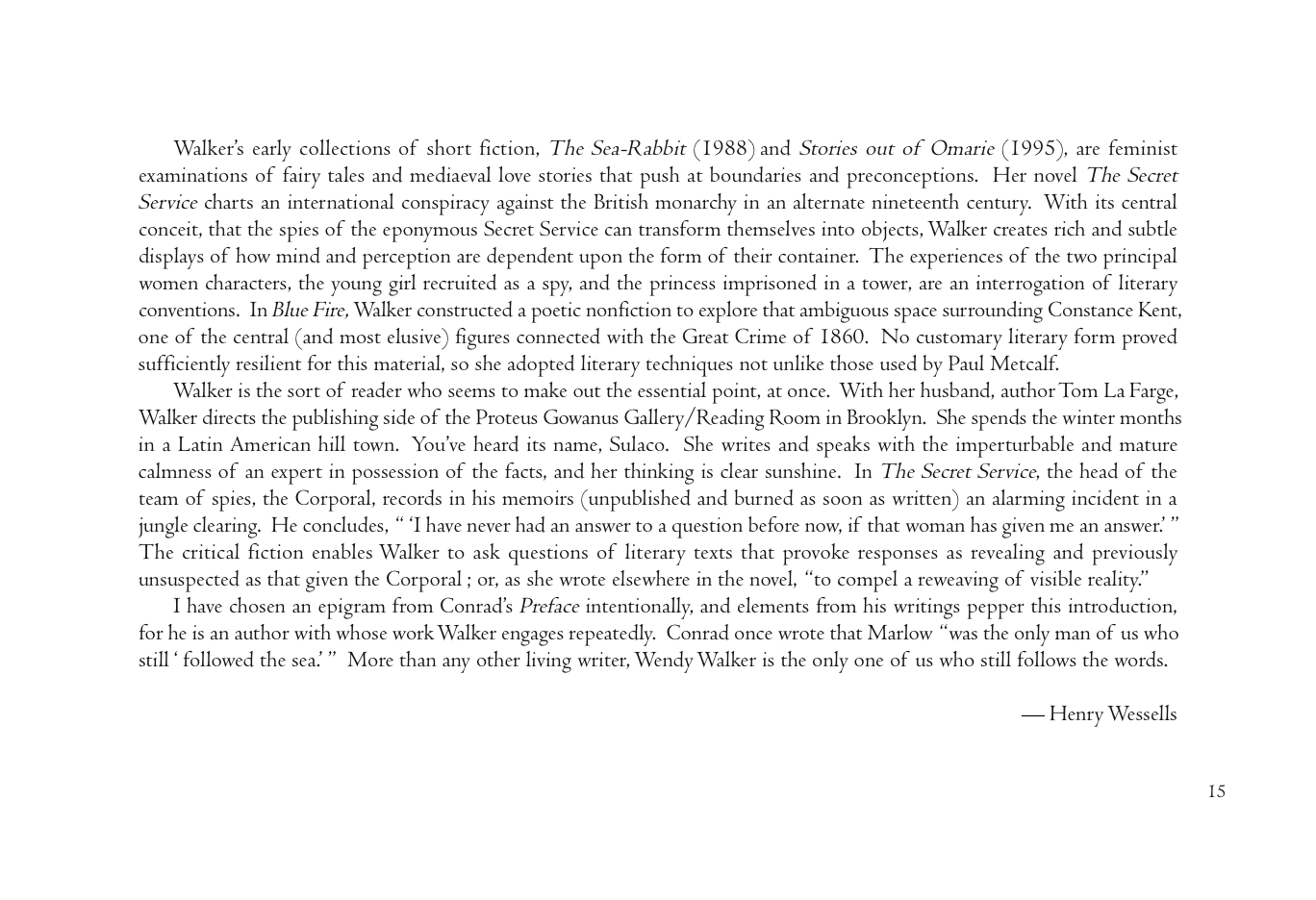
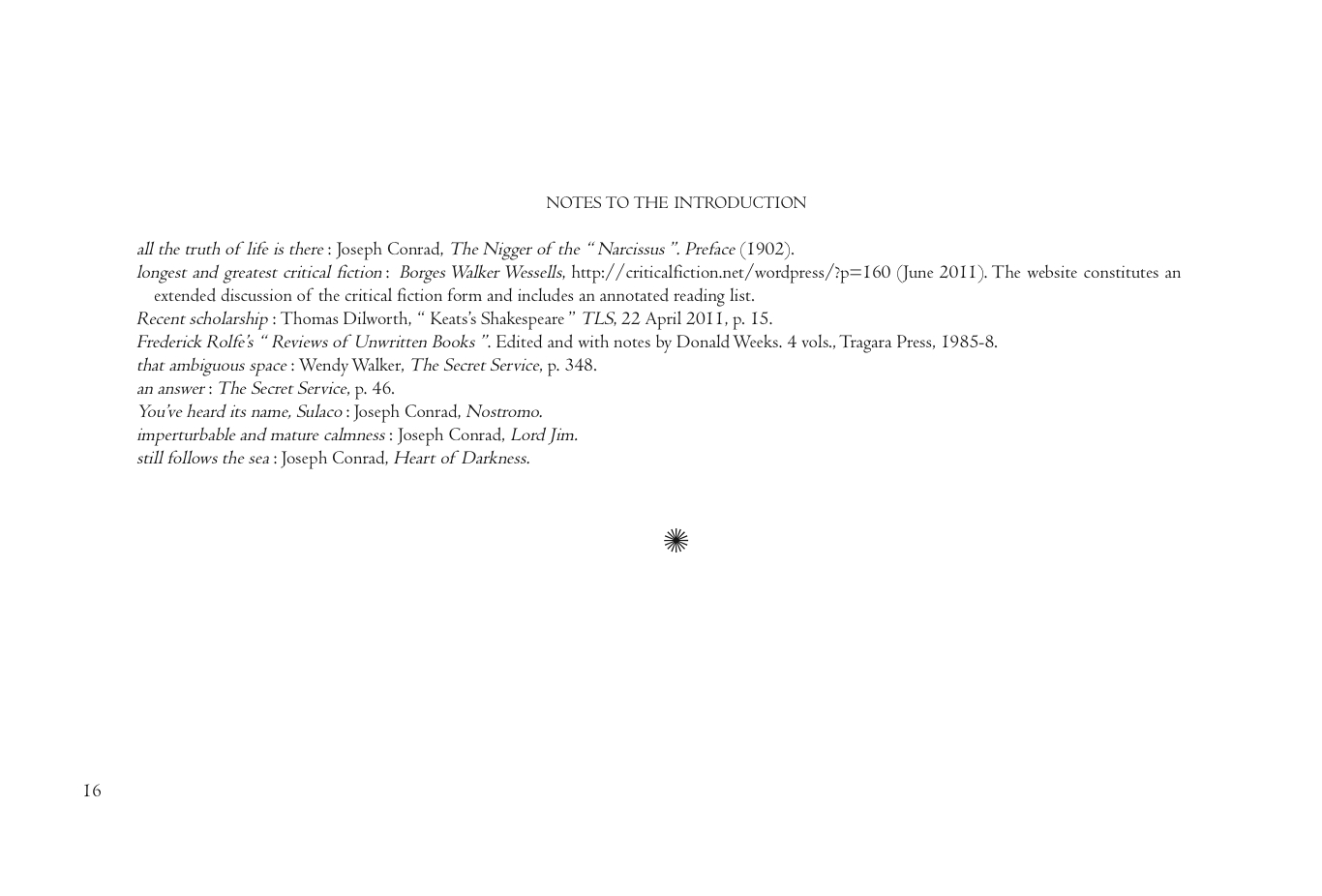
Here is the introduction to Wendy Walker’s new book, My Man and other Critical Fictions (For a full size view click on individual pages, or for a full size pdf view click here). To buy the book, follow the My Man tab up top.

[HWW]


My Man and other Critical Fictions
Wendy Walker. Temporary Culture, $22.50 (138p) ISBN 978-0-9764660-7-9

A critical fiction, as publisher Henry Wessells explains in his introduction to this collection of eight eclectic tales, is “a work of art that explicitly declares itself as a critique of another work of literature.” Mixing collage and Burroughs-esque cut-up technique with traditional narrative, Walker (Blue Fire, a Poetic Nonfiction) presents works that veer from the whimsically self-reflective to the fragmented and obscure. In “A Document from the Secret Archive of Grent Oude Wayl, Esquire,” the language of the story becomes a landscape navigable by the inhabitants of the country it describes. “Being nothing content” alternates a historical account of King Lear with cut-and-pasted strings of words whose chaos reflects the turmoil of Lear’s personal drama. Similarly, “Hysterical Operators: The Inspector of Factories Visits the Lover of Melodrama” intertwines linear and non-linear narrative strands that evoke the opposing personalities of the titular characters. Though the literary works Walker critiques are not always identifiable, it is not necessary to be familiar with them to appreciate the creativity and experimentation she displays. (Nov.)

Reviewed on: 10/31/2011

The Critical Fiction Symposium, held at the Grolier Club in New York City last night, was a success on all counts. Wendy Walker’s book, MY MAN AND OTHER CRITICAL FICTIONS was published and the beautiful subscribers issue was also on view. An engaged and intelligent audience of approximately 35 to 40 people gathered to see WENDY WALKER, RON JANSSEN, JENNIFER NELSON, JOHN CROWLEY, and HENRY WESSELLS discuss the critical fiction mode, with numerous examples mentioned in the course of the conversation. An audio recording of the Symposium is available for listening here (1 hr. 12 mins.) through the courtesy of P. Richardson. There were many interesting aphorisms and exchanges; your correspondent cites a few now and will add to this list as other sections are transcribed.

“Every text contains its own critique.” — Wendy Walker

“Anything that breaks down genre categories as currently constructed is to my mind a good thing.” — Wendy Walker

“the way you use language out of the texts, and especially the pieces in which you’ve let the text literally flow across the page, it feels to me in reading that the language is liberated” — Ron Janssen

Discussing “Olaudah Equiano Crosses the Ice”, Walker said one aim was to “call attention to the lostness of the book. The slave narrative is well known, but nobody talks about the fact that Olaudah Equiano was writing this book on a journey to the North Pole” (an early journal he was subsequently obliged to abandon).

In closing, a member of the audience, Carrie Cooperider, made a comment that drew upon Heidegger’s  Poetry, Language, Thought: “he writes, ‘in the vicinity of the work we are suddenly somewhere else than usually we tend to be’ and it is critical fiction’s great gift that it allows us to be displaced by the work of art and to be somewhere where we tend not to be.”

Order the book here, join in the discussion!

Temporary Culture and Henry Wessells are pleased to announce a Critical Fiction Symposium on Tuesday 25 October 2011 to celebrate the publication of a new book by Wendy Walker.

MY MAN & OTHER CRITICAL FICTION is an original collection of 8 critical fictions on Joseph Conrad’s Nostromo, King Lear, Olaudah Equiano, Harry Mathews, and other writers and texts. The critical fiction is a literary mode that takes as its subject another literary work and treats of that work’s construction, obsessions, and sources in narrative and poetic, rather than expository/critical terms. Wendy Walker is one of the chief proponents of the critical fiction today; some of her predecessors include Jean Rhys, Jorge Luis Borges, Angela Carter, and Guy Davenport. Participants will include WENDY WALKER, RON JANSSEN, JENNIFER NELSON, JOHN CROWLEY, and HENRY WESSELLS. Join us for an evening of wide-ranging literary conversation.

WENDY WALKER is author of a modern masterpiece, The Secret Service (1992), and the formally innovative Blue Fire, A Poetic Nonfiction (Proteotypes, 2009), and several collections of short fiction. With her husband, author Tom LaFarge, Walker directs the publishing side of the Proteus Gowanus Gallery/Reading Room in Brooklyn. She is at work on Sexual Stealing, an inquiry into the origins of British Gothic fiction in eighteenth-century Jamaica and Haiti.
RON JANSSEN is co-translator of three volumes of short stories by Chinese author Can Xue and teaches courses in exploratory writing and comparative rhetoric at Hofstra University.
JENNIFER NELSON recently completed her M.F.A. in poetry at New York University and is a doctoral candidate in the history of art at Yale University.
JOHN CROWLEY is the author of Little, Big and the acclaimed Ægypt quartet. He teaches creative writing at Yale University.
HENRY WESSELLS is author of Another green world and publisher of Temporary Culture and the Endless Bookshelf. He is an antiquarian bookseller with James Cummins Bookseller in New York City.

Date : Tuesday 25 October 2011, 6:00 to 8:00 p.m.
Location : The Grolier Club, 47 East 60th Street, New York, NY 10022.
RSVP to : Tom La Farge, tel. 917-400-2187 ; or Henry Wessells, electronym wessells@aol.com

Copies of MY MAN & OTHER CRITICAL FICTION will be available for purchase at the Symposium. The author will be pleased to sign copies afterwards.
Temporary Culture is pleased to report that My Man and other Critical Fictions by Wendy Walker is in press and on schedule for release in late October. It will be a beautiful book.

Subscriptions to the hand bound issue (signed by the author and artists) are now being taken, as well as advance orders for the trade issue. Details here

Here is the table of contents :


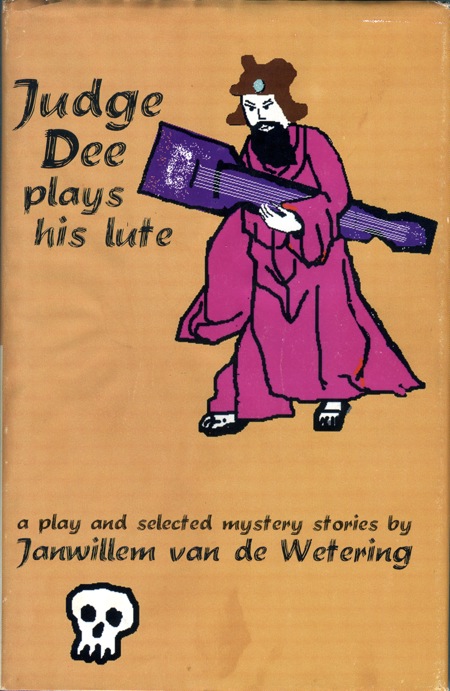
Today I would like to add a new entry to the critical fiction reading list in honor of Janwillem van de Wetering, Dutch-born author who died in Maine three years ago today:

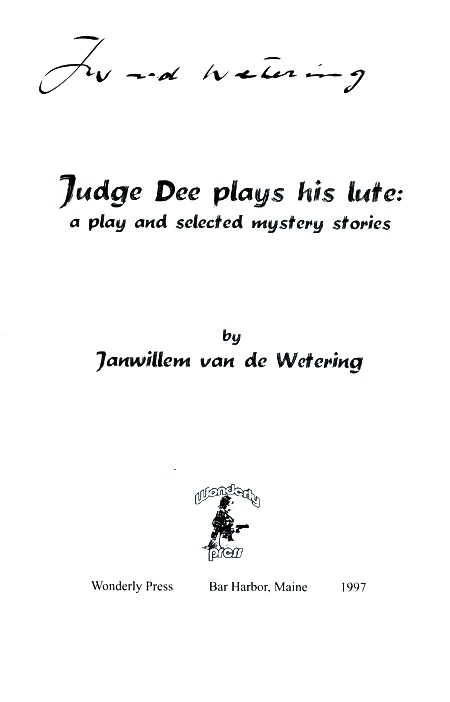
Janwillem van de Wetering. Judge Dee Plays His Lute: A Play and Selected Mystery Stories. Bar Harbor, Maine: Wonderly Press, 1997. Cover illustration by the author.

The radio play that gives this book its title is a critical fiction of the life and writings of R.H. van Gulik, Dutch sinologist, diplomat, and detective novelist, in the form of a vision or daydream at van Gulik’s funeral. It was the starting point for my discovery of the writings of Janwillem van de Wetering. His novel The Japanese Corpse (1977) includes a character based upon van Gulik, who was the Netherlands ambassador to Japan at the end of his career. I came across a copy of Judge Dee Plays His Lute a few months after writing a lengthy article on van Gulik (available here). I wrote to van de Wetering and in the course of our correspondence* interviewed him for an issue of AB Bookman’s Weekly published when he was guest of honor at Bouchercon in 1998 (that article is available here). We first met at the convention, where as guest of honor he was to be interviewed by Carl Hiassen. After lunch, he, remarked, Now it is time for the bear to dance. That phrase lodged itself somewhere in my memory, colliding with recollections of the Zen fable ‘Ten Bulls’ and aspects of the detective story, and so my own readings of van de Wetering’s novels and memoirs prompted me to write — very, very slowly — “Ten Bears; or, a Journey to the Weterings (A Critical Fiction)” (The New York Review of Science Fiction, October 2003; collected in Another green world, 2003).

For me, as writer and as reader, critical articles are (sometimes) simply not sufficient response to the many pleasures and challenges that another writer’s work elicits.

* A correspondence that continued until shortly before his death on 4 July 2008. He was 77, and that spring had written me a farewell letter remarkable for its clarity and directness in confronting death, but then he had written some years ago :

“ Perhaps he didn’t mind if he died, the commissaris thought. He thought death was exciting, a journey — he liked journeys. ”

On Critical Fiction : Tom Whalen interviewed by Henry Wessells


Tom Whalen is a novelist, poet, critic, short story writer, and (since 2008) visiting professor of film at the Staatliche Akademie der Künste in Stuttgart — his essay on Lola rennt (1998; Run Lola Run, 200) is wide ranging in its allusions and compelling in its insights, and serves as an example of his writing inthis discipline. It is his critical fiction work in prose and verse in the  form that caught your correspondent’s attention, namely “On Henry James’s ‘The Great Condition’”  in the current issue of  Marginalia. His most recent book is a work of criticism (not critical fiction) published by the Dalkey Archive PressThe Birth of Death and Other Comedies: The Novels of Russell H. Greenan. His website is http://www.tomwhalen.com.


HW: Would you be amenable to answering a few questions about the critical fiction form and how it fits with your writing, for use on the CF Forum?

TW: Sure.

HW: Nothing onerous, I hope. I guess I am as interested in the why? underlying the critical as in the technical choices you make in your writing.

TW: Das ist eine gute Frage: why the critical mode?  It’s fun; it doubles (at least) the capacity of one’s brain; it offers strange, deviating paths for a fiction to follow.  I also appreciate its defiant, transgenre stance, which frees me to experiment.  Or maybe it’s as simple as: I read a lot, and sometimes I like to write fiction about what I read.

HW: Wendy Walker has observed that some of your other stories are very similar to your critical fictions.  Is this a case of same well, different shape bucket?

TW: Not quite.  I’m not sure which stories exactly Wendy Walker has in mind, but, yes, in, say, the Encyclopedia Mouse Quintet (Books III-V have yet to appear) I critique genres, parody styles, insert essays and philosophical musings, use writers and philosophers — Wittgenstein, Walser, Hegel, Poe, Heidegger (EM’s bête noir), Swift, Homer, etc. — as minor but important characters.

I’ve also published several essayistic fictions like “In the Restrooms of Europe” (Yellow Silk, and in the anthologies The Book of Eros and Brief Encounters), “Louisiana: A Gay Essay” (Fiction International), “Le Nouveau Roman” (Report from the Dump, Obscure Publications), the story as personal article (“Conversations with Godard,” Agni), and several works that to me are more essay than fiction, but still both.  “Is your piece ‘The Europeans’ nonfiction or fiction?” one editor asked.  I answered that it was about 85% nonfiction, but that the remaining 15% makes me call it fiction.  He quickly rejected it.

And then there’s the out-of-the-box (or in-the-wrong-box) comic novel I wrote with Daniel Quinn, A Newcomer’s Guide to the Afterlife: On the Other Side Known Commonly as “The Little Book” (Bantam, 1997), which employs a host of nonfictional forms and strategies.

So regarding some of my fiction, Wendy Walker is right, but it’s not always drawn from the same well.

HW: Does your approach to composition of a critical fiction differ from the writing of other stories?

TW: Yes, especially when you consider that most of my stories, whether realistic or fantastic, are more strictly character-centered.  Recent stories such as “Rudolph’s Story” (Fiction International), “The Children Beneath My Window” (Ninth Letter), “The Effect” (The Literary Review), “The Installation” (Green Mountains Review), “Apotheke” (Southern California Review), “From the Life of a Project Manager” (New Ohio Review), “German Female, 27” (Natural Bridge), “My Neighbor” (The Hopkins Review), and “My Father’s Coat” (Agni) neither partake of nor parody critical strategies.  Certain structural principles and dynamics stay the same, yes, but the mode of narration is different.

HW: And your literary and film criticism, any similarities with your critical fiction?

TW: Clearly they’re not fiction, but I try when possible to make my critical prose as lively, albeit not as imaginative, as my critical fiction.  In my essay on Conrad’s “An Outpost of Progress,” written for a teacher’s manual to an anthology of post-colonial short stories I co-edited with Angelika Hoff, I couldn’t take a bike ride with Conrad in the middle of my analysis, but in my critical fiction on the same story, “Carlier and Kayerts” (Witness), I did.

HW: Do you intentionally set off from a source text or do you find yourself drawing such material into a work of fiction as it emerges?

TW: Both can happen and have.

HW: You seem to come back to the work of Henry James and Robert Walser as subjects for critical fiction. What prompts this?

TW: Because they were both born on April 15?  I love the demands these two masters make on me as a reader, how both of their works (I’m thinking of late James when I say this) track and remake consciousness with their syntax.  My relationship to their works has been long-lasting, intense and thus personal.  Writing critical fictions with James or Walser as the subject is, in part, a way for me to pay homage to what they continue to give me.

HW: Who else are you reading?

TW: During the past two weeks I’ve read the prolific Argentine short novelist César Aira’s The Seamstress and the Wind and Spanish novelist Enrique Vila-Matas’s Never Any End to Paris, both just out with New Directions.  (The three novels in English by Vila-Matas, by the way, are good examples of the novel as critical fiction.)  And I read Animalinside, a novella by the Hungarian László Krasznahorkai with art by Max Neumann, a German painter (New Directions), and Mark Ford’s translation of Raymond Roussel’s long poem New Impressions of Africa (Princeton).

Before that I had just come back from teaching a block seminar in Freiburg on American Crime Novels (1946-1969), my reading or rather re-reading for which included In a Lonely Place by Dorothy B. Hughes, The Long Goodbye by Raymond Chandler, A Rage in Harlem (For Love of Imabelle) by Chester Himes, We Have Always Lived in the Castle by Shirley Jackson, The Killer Inside Me and Pop. 1280 by Jim Thompson, and The Tremor of Forgery by Patricia Highsmith.

Next up: Mark Polizzotti’s new translation of Roussel’s novel Impressions of Africa (Dalkey Archive) and an online translation of Thomas Bernhard’s Ungenach.

And of course I’m eager for October to arrive, when New York Review Books will bring out a new collection of Walser’s prose, Berlin Stories, translated by Susan Bernofsky.

[The interview was conducted in an e-mail correspondence, 2-3 July 2011.]

A selective checklist of critical fictions by Tom Whalen

“Henry James.” Northwest Review Vol. 41, No. 2 (2003), 124-25.

“On Henry James’s ‘The Great Condition.’” Marginalia 5, 89-90.

“Carlier and Kayerts.” Witness Vol. XXII, 101-02.

“Maisie.” Coe Review Vol. 37 No. 2, Spring 2007, 4-11.

Twenty-Six Novels. Black River Falls, WI: Obscure Publications, 2001.

Walser Wandering. Black River Falls, WI: Obscure Publications, 2009. (“Herr Walser on a Stroll Encounters Monsieur Satie Striding,” “Walser Wandering”).

“On Robert Walser’s Birthday.”  Crosscurrents Vol.5, No.3, 87. Maryland Poetry Review Vol.1, No.3, 6. From a Bend in the River: 100 New Orleans Poets.  Kalamu ya Salaam, ed.  New Orleans: Runagate Press, 1998, 209.

Winter Coat. Red Dust, 1998, 7.

“From Eleven Novels (“Rendezvous in Erlangen,” “The Bicycle and the Canary,” “Moon Story”).  Sentence 8, 115-16.

(“Lake Sketch for Little Girls.” Alice Redux. Richard Peabody, ed. Arlington, VA: Paycock Press, 2006, 317-319. On Carroll’s ‘Alice’.

“Le Nouveau Roman” (Report from the Dump.  Obscure Publications, 2001, 1-3).

-30-

Older Posts »